
Pattern Design: The Art of Creating Repeating Patterns
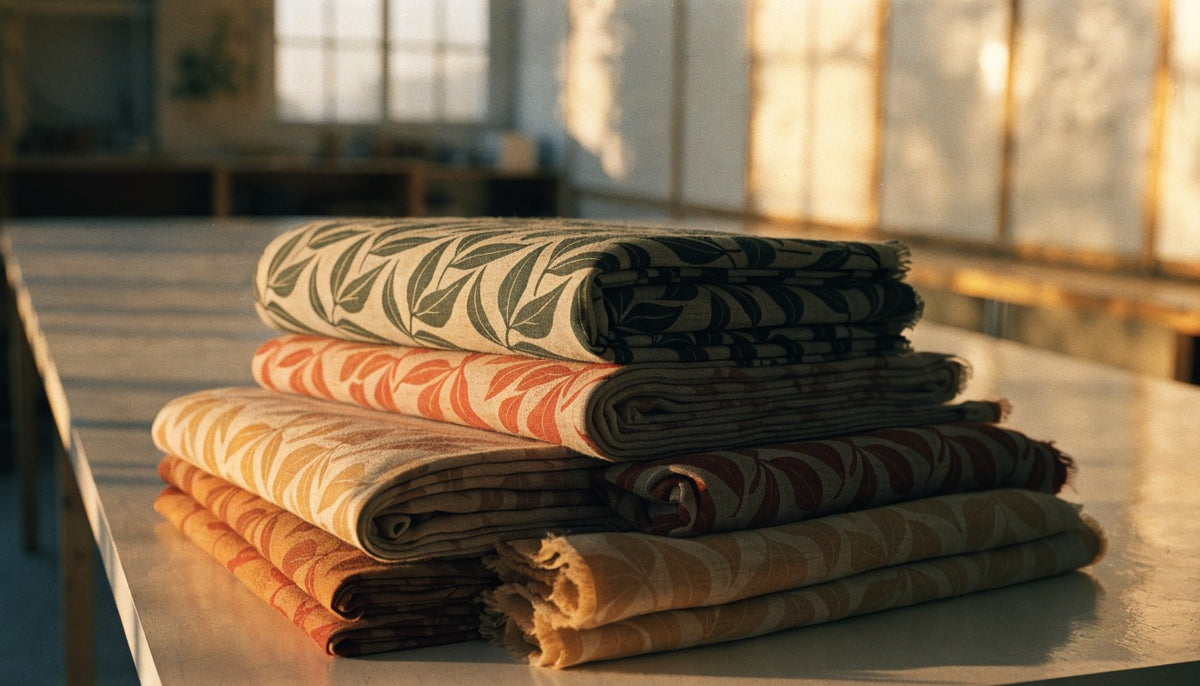
Key takeaway: pattern design is about more than aesthetics—it is visual engineering built on the "repeat," the creative unit duplicated endlessly with no visible seam. This technical mastery turns ordinary surfaces into unique artistic narratives, giving furniture and décor a distinctive signature for a personalized way of living.
Have you ever wondered how a simple sketch can become an endless, harmonious print capable of completely redefining the look of a living space or an everyday object? To help you master that subtle balance between technical rigor and visual poetry, we explain in detail what pattern design is and how creating repeating patterns works. From the mathematical construction of the repeat to the choice of colorways, learn how to design the unique graphic textures that give our furniture collections a strong and lasting identity.
- Pattern Design: Much More Than a Pretty Drawing
- The "Repeat": The Secret of a Successful Pattern
- The Different Repeat Techniques for Creating Rhythm
- The Pattern Designer's Creative Process: From Idea to Final File
- The Pattern Maker's Tools: Between Craft and Digital
- Where Does Pattern Design Come to Life? From the Runway to Your Terrace
Pattern Design: Much More Than a Pretty Drawing
What Exactly Is Pattern Design?
Pattern design is the art of creating visuals made to multiply endlessly across a surface. We are not talking about a single, isolated image, but about a structure designed to clothe a material.
It is a specialized branch of surface design. The technical goal is to achieve absolute visual continuity, where the eye detects no awkward seams. Experts often use the term "surface pattern design" to describe this mastery of graphic flow.
The principle is the same everywhere: the pattern must be able to work on any medium, from upholstery fabric to wallpaper.
Not to Be Confused with Computer Science
If you type this term into a search engine, you will probably land on code. "Design patterns" in software development do exist, but they have absolutely nothing to do with graphic design.
For a developer, a "design pattern" is a standardized technical solution, a template for solving software architecture problems. Here, we focus solely on the creative and visual side of pattern design, far from complex algorithms.
In short, we are talking about art, décor, and emotion—not command lines.
The Difference Between a Repeating Pattern and a Placement Design
Pure pattern design creates a repeating pattern, often called an "all-over," that duplicates infinitely. You see it on a roll of fabric or wallpaper: the major advantage is that the material can be cut anywhere.
By contrast, an engineered design (or placement print) is a single visual fixed at a strategic spot on the product. Think of a logo centered on a T-shirt or specific embroidery along a border; its position is final.
A skilled textile designer often juggles both techniques depending on the project's constraints.
The Basic Motif: The Foundation of Everything
Everything starts with the basic motif. It is the smallest graphic unit that, once multiplied, generates the entire pattern. It is literally the DNA of the design, the fundamental building block that carries the visual identity.
It isn't just artistic; it is also mathematical. This module follows a strict repetition rule to build a coherent, cyclical visual structure. It is this rigor that turns a simple drawing into a usable texture.
The "Repeat": The Secret of a Successful Pattern

What Is the "Repeat" (or "Rapport")?
Forget the apparent complexity for a moment. The repeat is simply the basic unit, the graphic stem cell of your pattern. It is the precise rectangular or square block that we will duplicate.
The real magic happens as soon as this single tile is lined up. Placed side by side horizontally and vertically, the block disappears to create a coherent, rhythmic whole. The goal is always to form a continuous, flowing pattern on the fabric.
It is the mother cell that dictates the entire design. Without it, there is no pattern.
The Keys to a Good Repeat: Flow Above All
Let's be clear: the quality of a pattern depends entirely on the technical design of its repeat. A bad repeat is unforgiving.
To succeed, you need to meet three essential technical criteria:
- Repetition with no visible seam: the edges must connect perfectly, down to the pixel.
- Continuity and flow: the pattern must feel natural, with no break in rhythm.
- Infinite print potential: it must work at any surface scale.
The human eye should never be able to guess where the repeat tile begins or ends. If you can see the grid, the illusion collapses immediately. This is exactly the detail that separates an amateur design from a polished, professional pattern.
The Challenge of the Invisible Seam
The "seam" is the critical junction between two instances of the repeat. This is where everything is decided for the designer. It is the technical friction point of the design process.
The slightest offset or the faintest visible line ruins the illusion of an infinite pattern. The mistake jumps out and breaks the atmosphere. Technical perfection is therefore non-negotiable for us.
The real challenge of pattern design isn't just creating a pretty drawing, but designing a unit that melts into infinity, where the eye can make out neither beginning nor end.
The Different Repeat Techniques for Creating Rhythm
Once the repeat is defined, the designer must choose how it will be repeated. The type of repeat chosen radically changes the final look of the pattern.
The Main Types of Pattern Repeats
Have your basic repeat? Perfect. Now you need to choose its choreography. There are several repeat "grammars" that transform the final look. It is this technical choice that determines whether your pattern will appear static, flowing, or downright hypnotic on a canvas.
Textile designers mainly juggle four major families to personalize an outdoor space. There is the simple block repeat, the staggered offset (or half-drop), mirroring, and rotation. These techniques make up the designer's essential toolbox.
Comparing Repeat Methods
To grasp the subtle nuances between these techniques, nothing beats a side-by-side comparison. Each method imposes its own rhythm and shapes a distinct visual mood. Here is what you need to know to choose the right style.
| Repeat type | Principle | Visual effect | Ideal for... |
|---|---|---|---|
| Simple repeat (Block / Straight Repeat) | The repeat tile is arranged in a grid, aligned horizontally and vertically. | Structured, formal, predictable. | Simple geometric patterns, stripes, polka dots. |
| Half-drop repeat (Half-Drop / Brick) | Each new column is offset by half the height of the repeat, like a brick wall. | More dynamic and natural; breaks the rigidity of the grid. | Floral patterns, characters, organic elements. |
| Mirror repeat (Mirror Repeat) | The repeat tile is reflected along the horizontal or vertical axis with each repetition. | Creates symmetry effects, complex shapes, and kaleidoscopes. | Abstract patterns, Art Deco–inspired designs, Rorschach effects. |
| Rotation repeat (Rotation Repeat) | The repeat tile is rotated (e.g., 90° or 45°) with each new instance. | Highly complex, geometric, hypnotic. | Optical illusions, intricate tile patterns, psychedelic designs. |
The Pattern Designer's Creative Process: From Idea to Final File
Understanding the technique is one thing, but how is a pattern actually born? The process is a mix of pure creativity and technical rigor.
The Key Steps in Creating a Pattern
Many people imagine pattern design as bohemian improvisation, but that's a mistake. It is a meticulous process in which creative freedom relies on an unbending technical structure to guarantee a professional result.
- Research and inspiration: A strong theme and palette are defined through a precise moodboard.
- Creating the elements: Hand or digital drawing of the icons, textures, and shapes that make up the visual.
- Composing the repeat: Strategic arrangement of the elements within the repeat tile to achieve balance.
- Testing the repeat: Checking the seams to ensure flow that is invisible to the naked eye.
- Coloring: Developing color variations—the famous "colorways"—to multiply the moods.
- Preparing the technical files: Strict compliance with specifications for final printing or weaving.
Inspiration: The Starting Point of Every Design
Everything starts with a visual narrative. A pattern is not a mere accumulation of geometric or floral shapes; it is a language that must evoke something visceral in the viewer.
The moodboard then becomes the central tool of this phase. This patchwork of textures, photographs, and color swatches sets the overall mood and keeps you from scattering your efforts during graphic design.
Every successful pattern begins long before the first pencil stroke; it is born of an observation, an emotion, a moodboard that captures the essence of a story waiting to be told.
From Colorways to Technical Files
Next comes the subtle play of "colorways." A single pattern can tell two opposite stories depending on its hues: a vibrant version for a summer terrace, or a muted one for a winter interior.
The final stage is purely technical: preparing the technical files. The designer must deliver a flawless document to the printer: 300 dpi resolution, CMYK mode, and bleeds are all checked to guarantee defect-free production.
It is the final bridge between the designer's imagination and the reality of the object.
The Pattern Maker's Tools: Between Craft and Digital
Essential Pattern Design Software
Let's be honest: the vast majority of designers today work digitally. It is the current standard for working more efficiently.
- Adobe Illustrator: The absolute standard for vector drawing. It is the ideal tool for crisp patterns that can be resized infinitely.
- Adobe Photoshop: Perfect for working with rich textures, painted patterns, or photographic, bitmap-style renderings.
- Procreate: The go-to iPad app for fluid digital drawing that keeps a spontaneous, hand-drawn touch.
- Affinity Designer: A powerful, subscription-free alternative to the Adobe suite, increasingly popular with creatives.
The Artist's Hand: Traditional Techniques and Digitization
That said, going fully digital is not an absolute must. Many artists deliberately start on paper to preserve the warmth and imperfection of handmade work. They are after that particular grain that pixels sometimes struggle to imitate.
Techniques such as watercolor, gouache, marker drawing, and even collage are common. These authentic creations are then scanned at very high resolution so they can be used.
The computer work then simply consists of cleaning up the lines, composing the technical repeat, and adjusting the colors.
When Code Becomes a Paintbrush
A more avant-garde approach is also gaining ground: creating patterns with code. Certain languages and tools make it possible to generate complex visuals algorithmically. It is a fusion of pure logic and aesthetics.
The Turtle library in Python is a fitting example. It lets you draw complex geometric shapes by programming movements. It is another, more mathematical facet of pattern creation.
Where Does Pattern Design Come to Life? From the Runway to Your Terrace
Ultimately, what is all this for? Patterns are everywhere: they dress our everyday lives and turn ordinary objects into pieces with character.
The Endless Applications of Pattern Design
Look up for a moment. Patterns fill our field of vision, often without our really noticing. They punctuate urban concrete just as they do our private interiors.
Look at the fashion and accessories passing by in the street. Observe the home décor that surrounds us, or the furniture we sit on. Even stationery and packaging are getting in on it now.
Every sector uses these repetitions to forge a strong identity. It is the silent language of visual emotion.
The Pattern as a Signature in Fashion and Décor
In fashion, the pattern is not a detail—it is a manifesto. It turns simple fabrics or scarves into cult emblems. Think of those organic cotton shopper bags that become true walking canvases for self-expression.
At home, the pattern sets the atmosphere. It appears on wallpaper, curtains, and bed linens. See how design cushions like our "Graphic Bloom" instantly tell a story.
It is the most powerful tool for making a place your own. Without it, a space remains silent and impersonal.
At SÉZONS, Pattern Reinvents Outdoor Furniture

At SÉZONS, we reject bland, uniform garden furniture. Pattern design is the beating heart of our creative approach to outdoor furniture. A simple wooden deckchair with a one-of-a-kind design becomes a statement of style.
Our signature patterns, "Modular Vibration" and "Intuitive Structure," are born from close collaboration with talented artists. We design these visuals as precise repeating units. They then boldly dress our deckchair fabrics, cushions, and bags.
This is our vision of a distinctive outdoor way of living. Your terrace deserves better than gray plastic.
Beyond the technical rigor of the repeat, pattern design is a true emotional language that elevates everyday life. By bringing these singular creations into your world, as with our SÉZONS collections, you turn your outdoor space into a place of unique expression. Let art tell your story, one pattern at a time.
Share:
Surface Design: Definition and Branches of a Creative Art
Textile Design vs. Pattern Design: The Art of Material